Mastering Time Signatures Made Easy
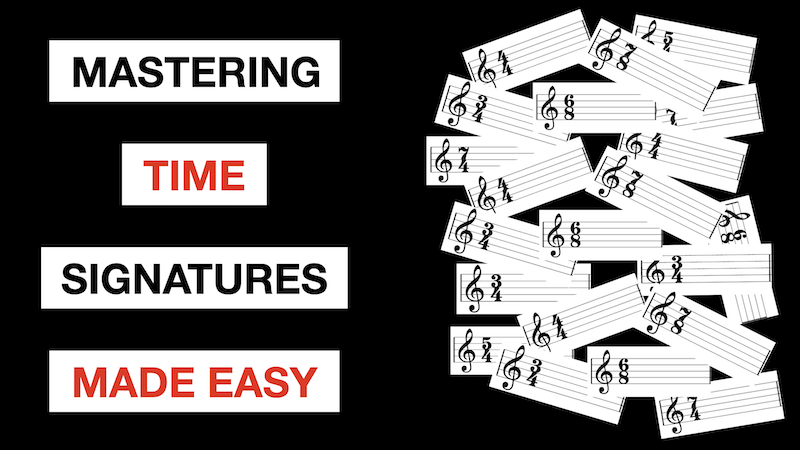
Think of time signatures as the gears of music, each one offering a distinct feel and rhythm.
Just as a skilled driver shifts gears with ease, a musician can switch between time signatures to craft diverse and captivating sounds.
In this article, we'll show you how to "shift gears" using a simple chord, exploring time signatures like the familiar 4/4, the waltz-like 3/4, the compound 6/8, and the quirky 7/8.
You'll discover that mastering these rhythmic changes is not only simpler than you might imagine but also a lot of fun.
By the end, you'll be equipped to mix and match time signatures, creating your own unique rhythms and adding creativity to your music
Transcript
Brian
The next idea is to start playing with time signatures immediately. The most popular music in the West is in 4/4. If you're into prog rock or world music, there's much more variation. Let's start in 4/4/ and then modify a basic idea to fit 3/4, 6/8/, and 7/8. This may sound difficult, but it is not.
One of my favorite things to have students do is take one chord and play an arpeggiated pattern. We will use a B power chord with some open stings added for this example.

If I were going to compose something from this, an easy thing to do would be to start moving the bass note around, but that is not what we are doing here. We are exploring time signature. We only have to remove two notes to change this to a measure of 3/4. Let's remove the last two.

The more you do this, the faster you internalize each time signature's feel. That will make it easier to play things and recognize what others are doing on a recording.
You can switch between these ideas without stopping if you want to push things.
A measure of 6/8 and 3/4 have the same number of notes, but the accent is different. In 3/4, you tap your foot on every beat. In 6/8, you only tap your foot on the 1 and the 4. Let's modify the pattern to highlight this difference.

Now, let's go back and forth between 3/4 and 6/8 without stopping.
The best part of this exercise is that your fretting hand does not move. All you have to do is change the pattern in your pick hand.
I am doing this on the fly. When starting out, it will work much better if you write out the patterns on paper first. It is much easier when you preplan something like this. Plus, you will probably develop something more interesting than what I am doing in real time.
You only need to take away one note to change the original idea to a 7/8 riff.

It is best to work on these ideas in isolation first. After that you can start combining them in pairs. We have already done that. Then, you can combine all of them in one composition like this.
This would sound even better if you could add other instruments to it. I like using Guitar Pro to work out ideas, but you can use any recording software if you are more comfortable with it.
Do you have anything to add to that, Mike?
Mike
Yeah, well, everything you said, especially with mixing up time signatures, brings up a concept that I teach to many of my students: thinking ahead to the next thing. I find that even when we're talking about technique and playing a scale sequence, some people struggle with remembering things because they're so focused on the current thing they're playing.
With these time signatures, when you're mixing, say, seven and four and then six, the key to doing this right is thinking ahead. You don't start thinking about the next time signature too late. You want to know where you are going so that you are caught by surprise. That will cause a lot of people to get off track and get off time. I'm sure you've seen this plenty of times.
Brian
Yes, I'm thinking almost a measure ahead. When I'm going to switch to three I think about that around a measure before it happens. You don't change your counting at that point but it is not a surprise when I get there and need to change my counting.
But you need to be confident in each time signature in isolation before mixing them up, as I just did.
Mike
Yes, yes. And, of course, the other thing is how much more fun it is. You can make a simple chord sound great and be more creative by just applying these simple ideas. This one concept cannot be overstated. I think many people try to do too much with rhythm right away. They try to add all these fancy chords and chord changes and stuff. But the actual rhythm itself kind of sucks.
And what you're teaching here, Brian is a good way to break out of that.
Conclusion
Understanding and creating music in different time signatures is a fantastic way to spark your creativity with rhythm. But it's just one piece of the puzzle. To really kickstart this process, you need a variety of tools in your arsenal. If you ever find yourself struggling to craft your own rhythmic variations I've got the perfect solution for you. "The guide to making any rhythm you know sound even better." It's a straightforward, no -nonsense resource packed with practical tips to unlock the full potential of any rhythm. Whether you think you're creative or not, this guide is designed for everyone, and I'll walk you through each step of the process to ensure your success. It's designed to help you break through creative blocks and elevate your ideas into something truly special.
Click the link below this video to grab your copy today and start unleashing your rhythmic creativity.
6 Easy Steps To Learn and Play Any Rhythm With Perfect Timing