How Do You Transcribe A Guitar Part You Can BARELY HEAR?

Imagine you're transcribing a song by ear. The chords? Got 'em. The melody? Easy. But then there's that guitar part — the one buried so deep in the mix you can barely tell it exists.
You squint at your speakers. You crank up the volume. You convince yourself you heard something... maybe?
At this point you have two options:
- Find a tab online and hope whoever made it has superhuman ears
Give up and become a drummer insteadLearn what the pros actually do in this situation
Here's the thing. That person who made the tab you're thinking of downloading? They listened to the exact same recording you're listening to. They couldn't hear that buried guitar part either.
And yet... they wrote out a tab anyway.
So what's their secret? Unbounded misplaced confidence They know how to transcribe with limited information. And honestly, once you know the trick, it's not that complicated.
(Quick story: I once had to transcribe the Game of Thrones theme for a guitar ensemble. Toward the end, they put in all these mechanical city sounds over the music, and you literally cannot hear the arpeggio part. So what did I do? I made it up! I knew the chords, I knew the style, I interpolated. Nobody ever noticed.)
The real skill isn't "hearing everything perfectly" — it's knowing when to work with what you have and when to... let's say, creatively fill in the gaps.
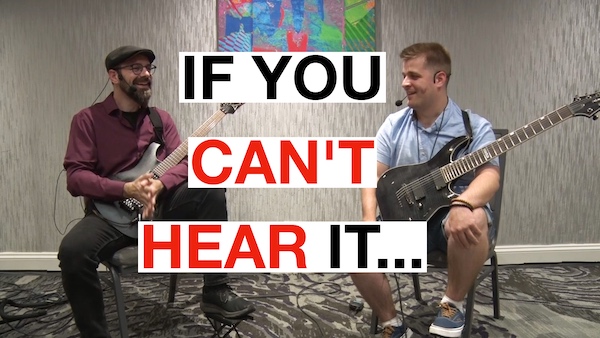
In the video below, I explain exactly how to handle this to a student who had this very question.
P.S. Hey, even some famous bands can't play their own songs exactly as recorded anymore because they forgot what the buried parts were. If they can't remember, you're allowed to improvise too.
P.P.S. One of the most important aspects of learning music by ear is actually having a properly developed vocabulary of musical building blocks, particularly chords and harmony. If you fully develop your vocabulary of chords, then you will be more likely to recognize those sounds in music and therefore know how to transcribe them. If you want to massively improve your knowledge and vocabulary of chords and harmony on the guitar, check out my Complete Chord Mastery guitar course
Video Transcription
Hello Internet, so nice to see you! Ear training is an important part of being a good musician and so a good guitar player. But ear training has some limits, okay? There are things we can and cannot do with ear training.
And today I want to address one of them because a student asked me, what do we do when we want to transcribe a song, but the guitar part is buried in the mix and it's barely, you can barely hear it. You can hear some, but you cannot hear all of it.
Okay. How do we transcribe that? What kind of tricks? What kind of systems? What kind of ideas we can have to transcribe something that we cannot hear clearly? Well, let's go and see. So I have a question about how to figure out songs by ear when sometimes the guitar part is buried by other parts of the song.
So like if the singer is singing over it or something else, I have to really listen to try and figure it out. If it was on its own, I might be able to do it. Yes. But it's very difficult when it's buried.
So I can find ways around that. Yes, it is. So you have essentially two solutions here. Solution number one is that if that guitar part is played somewhere else, then you just go somewhere else to transcribe it.
So if it's the same, if it's the second chord, but you can hear the first chord, vice versa, okay? You just piece together a guitar part from where you can listen to it. That would be the first thing.
So you're cheating. You're not transcribing the guitar part, you're transcribing the guitar part somewhere else. It's the same guitar part. I mean, hopefully. But the second solution is this. If you, who are a musician, who really cares about doing things precisely, because I know you, okay, can't hear the guitar part, is that guitar part that important?
If you play some other notes and it still fills it up, is that important? Not desperately. Not desperately. I like that. Not desperately. Exactly. Exactly. What we do is we try to make a difference sonically.
If you try to play a part and you sincerely go like, I don't hear a difference between my part and their part, and when it's buried in the mix, it will sound the same. You're done. You're done. You don't have to play exactly the same thing because nobody can hear that.
Once I was transcribing the theme of Game of Thrones for guitars, because we wanted to do an ensemble performance with a few guitars, center, etc. And toward the end there is this nice figuration part.
Okay, because they reprise the theme, but goes to different chords. And since they put in all the noises of all the mechanism of the cities moving around, you cannot hear the two parts of the thing. So I just wrote it.
What do you do? There's clearly something. You can attack all the strings. You know the chords because you transcribed the chords previously. You know the figuration and pretty much interpolate the thing and if there's something different nobody can hear it.
You just need to patch it up so that in your rendition it sounds good. Okay? Nobody will ever ever complain. That's one story. There's plenty of other stories like that. There are bands that made album with so many harmonies, Blank Guardian, okay in case you're wondering, that now they cannot even play the original version because they don't remember all the original parts and they can't transcribe because there are too many parts in harmony and like I don't know what I'm doing here and I can't hear it and we don't have the original tapes or something.
So if they can't, why would you? My point is that you put your energy where you can hear a difference. When you cannot hear a difference, you just make it up. Simple. It's not cheating. Or if it's cheating, we cheat.
Fine. Not a problem. You do what you can with what you have. That's the idea. More or less. As long as the final rendition sounds decent, good. And if it doesn't sound decent, that's maybe why they buried the guitar part.
Because it wasn't sounding good. I mean, there could be a number of things. Okay? Yeah. So, make it up. That's the idea. Do your best and then make it up. Okay, that's it.