STOP Playing Scales Up And Down: Harmonize Them With CHORDS

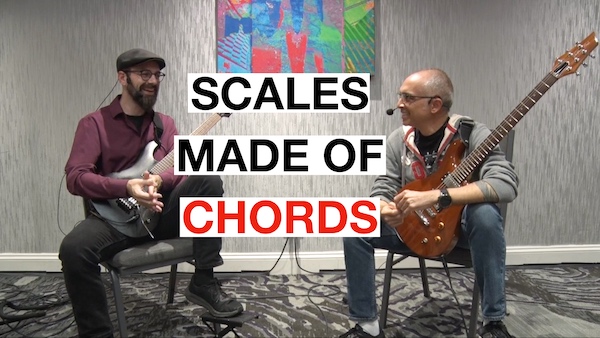
Every guitarist has been told to practice their scales.
The advice is sound. But there's a problem.
Running scales up and down has a hard ceiling. The first few times you do it, you're learning. After that the improvement curve flattens out, and you're mostly just moving your fingers around. Going through the motions.
So what do you do? Keep grinding at something that stopped working two months ago?
There's an exercise I call the killer fretboard knowledge exercise. (Yes, I named it. I can do that!) It covers fretboard knowledge, technique, harmony, AND arranging for solo guitar. All in one. Not five separate exercises. One!
Here's the basic idea: instead of running a scale with single notes, you harmonize each note with a chord below. Which means every pass through the scale is also training your harmonic ear, building fretboard knowledge in a musical context, and developing the exact skills you'd need to arrange a song for solo guitar.
In the video below, a student who's been working through triads all over the neck asks what else he can do. I walk him through three different approaches to the exercise, from simple to a bit more creative. Pick whichever level makes sense for where you are right now.
If the harmonic side of this gets you curious, the free eBook Finding Chords for Melodies goes deeper into how chords relate to scale notes. It's a good companion to what you saw in the video.
Video Transcription
Hello, Internet, so nice to see you.
People tell you that you have to practice your scales. They are not wrong, OK? But practicing scales, playing them up and down, up and down, up and down, is boring, OK? And there's a very sharp return on the investment, diminishing return on the investment. After a few times you play the scale up and down, you're not really improving that much.
Are there other ways to get to know our fretboard? Are there any musically relevant ways to get to know our fretboard that is not just playing scales or just finding the notes or just playing chord shapes? Yes, there are.
Let me show you what I call the killer fretboard knowledge exercise. If you can do this, and honestly, it's not even that hard, but if you do this, you're going to get everything, the maximum bang for the buck, because it's a fretboard knowledge exercise. It's a technique exercise, and it's incredibly musical.
And it also helps you being creative. And on top of that, it helps you arranging songs for solo guitar. You get all those things from a single exercise. And it's not even that hard.
Curious yet? Let me show you that exercise. In fact, let me show you when a student asked me about that, and we went through in details how to play that exercise.
I was working on triads all over the neck. So like if we were in C, and then I would go to and then keep on going all across on the four strings. And then same thing with the...
So I've been trying to learn the entire neck that way, and cycling through different keys every night whenever I practice. So I was wondering what else can I do to expand the knowledge of the fretboard and get a better understanding of the fretboard.
Oh, there's so much to mention in this. How much time do you have? How much time do I have?
One thing you can do is to start playing scales, but playing the chords below. What do I mean is this. Imagine you're playing, I don't know, something like, let's see what would be convenient here. Like a C major scale, starting from the C. Whatever pattern you're using, okay?
Now, when you play a C major chord, a C note in a C major scale, you can harmonize it with the C major chord. In this case I'm playing a first inversion, so the root on top, the 15th in the middle, and the 3rd on the bass. But now I'm doing this with all of them.
Oh, okay, yes. Okay, so I'm trying to play the whole scale. This way, essentially.
There is one chord I avoid, actually, because I like to play this chord here in second inversion rather than playing the diminished version here, or whatever it is. You can adapt it. You can play a sound you don't like, you can change a sound you don't like.
The point is, you just created a scale made of chords. And this can be done in so many different ways, depending on where you start.
So you're harmonizing the scale in chords? Yes. So the melody is the scale. And you can do this with any mode. And right now I'm harmonizing it mostly with first inversion chord.
Okay. At first, you'll have to think about it. Later, you can just find one or two shapes that you like, and you kind of optimize that. You learn to move a bit faster, etc.
There are many ways of fingering it. It's not that there is one way or bad way. You have to find some way to finger all that. Because you can finger it this way, but you can also finger it this way. And down here it would be this way, or again this way. But if you do it here, it's this way. Or this way, or this way. It depends.
You have to kind of study the problem and see what works best for you. And try different alternatives. So that's one possibility.
But you can also do another thing. Think of the C major scale. C, D, E, F, G, A, B. Those notes are harmonized by the C major chord. C, E, and G. Then we have the A.
And the A is kind of a parent note with those. Because the A will be harmonized with an A minor. And the A minor in first inversion still contains notes from the C major.
The other note can be harmonized by a diminished triad. I picked the worst thing. B diminished? Yes, because the other three notes are D, F, and B. And can be harmonized by a diminished triad instead.
So what I'm doing is I can play the scale and harmonize all the notes of C major and the A with the notes of C major. And all the B, D, and F with the note of the B diminished triad. To kind of have two colors in the scale.
So when I play C major, it's C major. Then I have the B diminished. This way. Top note C, chord is C major. Top note D, I have a B diminished triad. F, B, and D.
Next note is E. And I need to find the C major. Next note is F. And I have to find the B diminished triad. Next note is G. Next note is A. I just play an A minor in first inversion. Next note is B. I need to play B diminished. And so on and so forth.
If you don't like the passage between the G and the A, use an F major instead. To get a bit more variation. Now you can harmonize everything with two colors rather than seven colors.
So those are two examples. You can do whatever you want. You can harmonize the whole scale with 1, 4, and 5. You know what I mean? 1, 4, 5. Meaning you have three chords, C major, F major, and G major. And those three chords will cover the whole scale.
C, harmonize with C major. D, harmonize with G major. E, harmonize with C major. F, with F major. G with G major. A with F major. B with G major. And C with C major.
So instead of 1, 3, 5, 1, 4... OK. OK, the chords are still 1, 3, 5. You're using the first chord, the fourth chord, and the fifth chord. And with those three chords, you can harmonize the entire scale.
Now, once you've done the scale a few times, you now try to play a melody. You decide on a melody, and you try to see which one of those three ideas will work best on this melody. That could be a bit advanced.
OK. So the point is that rather than playing a scale with a single note, I'm playing a scale with chords below. And I can choose those chords in a thousand different ways. I just give you three.
OK? Just play the first inversion chord. Just play either the root chord or the seventh chord. Or just play the 1, 4, and 5 chord. OK. Those are the three ideas.
OK? If you don't remember those, you know what? Pick two chords. Seriously. It's not a problem. OK? Pick whatever makes sense. Put the fingers on the fretboard and see what sounds good.
Really, it's that. There is not one rule. There are a thousand. OK? See what sounds best to you. If something doesn't sound good, change chord.
You don't have to follow an idea just because it's an idea. But you find a few shapes of those scales with chords that you like. Then you invent a melody and play that melody that way. Not with a single note, but with the chords on the bottom.
And you say, some idea works best on some melodies, and so on and so forth. And you can start from there.
Right. OK. This is already a PhD program. OK. It makes sense. There's so much to find just in this idea.
Yeah. OK. So take it slow. Right. But that's how I would like to proceed. OK. Make sense? Wow. Thank you. Anytime. OK.