Your PINKY Isn't Broken — You're Holding Your Guitar WRONG

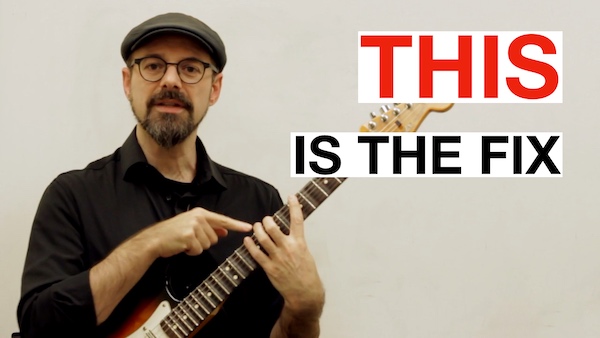
If your pinky curls inward every time you try to use it on the fretboard, I have good news and bad news.
The good news: there's nothing wrong with your hands. Everybody's pinky does that. It's basic human anatomy — the fingers are designed to close around things, not move in parallel lines.
The bad news: you've probably been blaming the wrong body part. The fix has nothing to do with your pinky and everything to do with your wrist.
It's The Wrist, Not The Fingers
When your wrist is straight and your thumb is on top of the neck, your fingers physically have to curl inward. But put the thumb behind the neck and allow a slight wrist bend, and suddenly those same fingers can splay out — dramatically increasing your reach.
How dramatic? In the video I demonstrate the difference: with the right wrist position, my pinky reaches from the 5th fret all the way to the 12th. With a straight wrist, it barely gets to the 9th.
If you're self-taught and want a structured path for what to study next, grab the free Map of Music Theory — it shows you what to learn in what order so you're not guessing anymore.
Video Transcription
Hello internet, so nice to see you. I got an interesting questions about the pinky finger in your fretting hand. I'm self-teaching myself guitar at 57 years old. My pinky is curled and making moves on my ring finger. It won't do anything I tell it to do. LOL.
It is bent. Very good. Everybody's pinky is bent. It's a feature of the anatomy of the human hands. The fingers are made to close around things. They don't move in a parallel way unless you keep them closed. The moment you open them, they all curl inside.
If you are a graphic artist, you actually study this when you learn to draw hands. If you are a physician, you study this when you study anatomy. The fingers move out radially, and so whenever you bend the pinky, the pinky is pointing in. Simple as that. It's not you, it's everybody.
There is a way around that and I'm going to explain it. It doesn't require breaking your fingers. You just need to know how the anatomy works and you will make it work. That's the first thing.
The other thing is that the pinky and the ring are not independent fingers. They are connected by tendons and in fact, it's not the pinky that is not independent, it's the ring that is not independent. The pinky is fairly independent from the first three fingers. The ring and the pinky are tied together and the hardest one to move is the ring, not the pinky. If you try to do this, if you put your hands together and you lift your index finger or the middle finger or the pinky, you can, if you try to lift the ring finger, it's much harder. It's the ring finger, the problem, not really the pinky.
Why when you play guitar, your pinky turns inward? And again, it's not bent, it's not strange, it's just how it is. The problem is how you put your hand on the fretboard. If you have your hand on the fretboard this way, you put your thumb on top and then you get this way and your wrist is perfectly straight, when you curve the finger around, your pinky will look in. You will have the index finger and the pinky and they will be pretty much at 90 degrees from one to each other.
And so, of course, if you do this, if you never bend the wrist, if you just come straight here, you put the thumb on top and you do this, you'll have the knuckle spread outside, but the finger tip is going to point in and you're not going to have much of an extension. This is, unsurprisingly, the wrong position.
The right position would be to put the thumb behind the neck of the guitar and slightly bend your wrist. What happens when you do this is that you are straightening up the hand this way and now the finger can open this way. I am not curling my fingers to reach the neck, I am keeping my fingers splayed out and moving them mostly from the first joint, from the proximal joint, to get to in position. The fingers are not bent much, the wrist is bent a little bit, but the fingers can splay out.
Do you see the difference? Meaning, if I do this and I splay out my fingers, that's my extension. And I'm bending the wrist. If I'm straightening up the wrist, the fingers automatically curl back in and I get less extension.
To give you an idea on how big this effect is, if I start with my index finger on the fifth fret of a strat and I bend my wrist, I can arrive to fret the twelfth fret on the sixth string. It's a bit of a stretch, it's not really painless, but I can do it. But I'm bending my wrist. If I insist on having this wrist perfectly straight, now my pinky barely, barely gets the ninth fret, but barely, and the other two fingers are kind of paralysed. And I've been playing a lot and stretching those fingers a lot, a beginner would probably arrive barely at the eighth fret, if ever. And it's hard, if I want to keep my wrist straight.
You can slightly bend the wrist. Now, here's the thing. If you force your wrist to bend, yeah, that's a problem. The idea is just to grab the neck of your guitar and relax the wrist a little bit, make sure the elbow and the wrist are relaxed, and just kind of naturally bend into it, but don't force the bend. Just let it bend and enlarge the fingers.
I made several videos on how to put the thumb behind the neck and that's why we're doing it. Because naturally, if you keep your wrist straight, the fingers curl in the moment you bend your wrist a little bit, your fingers can splay out. That's normal, natural human hand anatomy. There is nothing strange about that, okay?
You don't know this, it's because you are self-taught, okay, simple as that. This is one of the problems of being self-taught, is that you try, you use the wrong position or the wrong idea or the wrong theory, et cetera, and then you think there's something wrong with you. It doesn't matter if you are 27, if you're 47, if you're 57, if you're 87, it really doesn't. Okay?
If with the right position, your hands can be fairly efficient at pretty much any age, and you can learn at pretty much any age, okay? It's just that since you are old and you see your body being less efficient, you're like, ah, maybe I lost the train, maybe I cannot play guitar anymore. It's not the age, it's the position.
Find a teacher that can explain it to you, or just follow my indication right here. With the right position, you can play. It's not you, you are not diminished in any way here, okay, you have absolutely normal human hands. I mean, unless proven otherwise.
Guys, it is 2026. I've been insisting that you guys need to get a teacher from 2013, it's 13 years after. Guys, get a teacher, okay? It's stupid to waste decades of your life because you insist on doing this by yourself. Get a teacher. Somebody else can be the teacher. If you have somebody locally, find somebody locally. If you have somebody online, find somebody online. If you don't know what to do, come and ask me, okay? I know people all around the world, and I know several very, very good online teachers that can explain this to you very carefully and precisely. I can do that, other people can do that. Not a problem. Write me if you don't know what to do. But stop going at it by yourself.
It is not as hard, but there are things that are not obvious that nobody explains on the internet because they are boring. Was this explanation interesting for me? It was fairly boring to me. Nobody makes videos on this because they get very few views and all this kind of thing, but are important to you, so get a teacher. You are going to save so much time, and you're going to be able to play much better than you think, and you're not going to waste 10 years thinking that you have the wrong kind of hands, which you don't. You have the right kind of hands, like everybody else. This is Tomaso Zillio of MusicTheoryForGuitar.com, and until next time, enjoy.