SHARP 5 Or FLAT 6? Same Pitch, Different Sound — Here's Why

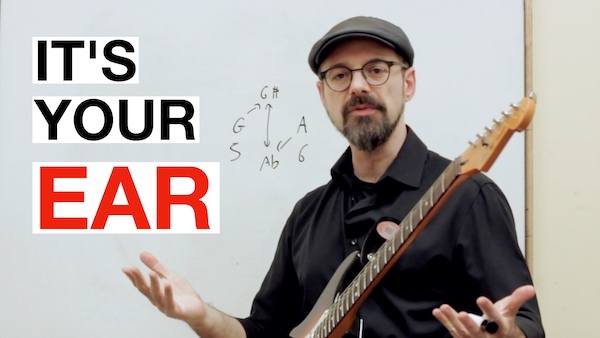
G sharp and A flat have the exact same pitch. Same fret, same frequency, mathematically identical. And yet, in a chord, one can sound dissonant while the other sounds consonant.
If that seems like nonsense, you're thinking about it as physics. But music isn't physics — it's perception. And your brain has some very particular ideas about what's happening when you play those notes.
Your Brain's Slot System
Here's the short version: when your brain hears a perfect 5th in the chord (say, C and G), it "fills the 5th slot." If the same pitch — G sharp/A flat — shows up, your brain reasons: "That can't be a sharp 5, because I already have a 5th. So this must be a flat 6." And it perceives it as consonant.
Remove the G, and the same pitch gets filed as G sharp — an augmented 5th — and now it sounds dissonant. Same note on the fretboard, different experience in your head.
The whole sharp/flat naming system? It's not describing frequencies. It's encoding how your brain interprets the context.
If you want to understand how context shapes every chord you play — and how to use that deliberately in your music — have a look at Complete Chord Mastery.
Video Transcription
Hello Internet, so nice to see you. I got an interesting question on the difference between a sharp 5 and a flat 6. You play one interval. It is both an imperfect consonance, minor 6, or a strong dissonance, augmented 5th. What makes the difference? The context in which you perceive it?
It is exactly that. It's the context in which you perceive it. And that's because your ear has a kind of a strange way to hear sounds.
The problem people have when they ask this question is that in our 12 tone equal temperament system, equal division of the octave, etc, etc, the sharp 5 and the flat 6 have the same pitch. Okay, so if I am in the key of C and my bass note is C, my 5th is G, my 6th is A, the sharp 5 will be G sharp, the flat 6 will be A flat, and those two notes have the exact, mathematically the same pitch.
Now, a lot of people will tell you, yeah, but if you don't use the equal temperament, those are different. Yeah, great, but that's not what we are using. We are using the equal temperament, and so those two notes are exactly the same pitch. Not the same note. They have the same pitch, physically speaking.
The point is, physically speaking, it's half of the truth, because what we are interested is not how those notes are physically, it's how they work inside your ear, because that's how you perceive it, and music is something that you perceive. The feelings are in your brain, the feelings are not in the notes. The feelings that music gives you are not in the frequencies, they are in your brain, so it's important to know how your brain works, and your brain does this weird thing.
The first thing your brain does is to check if there is a perfect 5th. If there is a perfect 5th, your brain tells itself, the slot for the 5th note is full, I already have a 5th, and so when they hear this pitch inside here, they're like, it cannot be G sharp, because I already have a G. It cannot be an augmented 5th, because I already have a 5th.
Now, while your brain does that, the reality is that nobody knows. We just know that it does that, okay? So if there is already a G, and you hear this pitch, this will sound like an Ab, so a flat 6th. You will get the sound of the flat 6th, it's considered a consonant in music theory, and it will sound consonant between C and Ab, there will be a dissonance with the 5th, but that's what it is, okay?
Even if it's not a G playing right now, if you played a G just before, and your brain remembered there was a G, this will still sound like Ab, because in the context, in the context of what you played just before, there was a G, that slot is full, that cannot be a G sharp. I mean, unless you force it, but that's another thing.
If instead there wasn't a G, and you hear this pitch, and there are other indications, for instance you put a major 3rd, and you play a G, and you just play a G sharp, now this E and this Ab are dissonant in a specific way, and your ear will perceive this as a G sharp, and the impression can be reinforced by playing the chord just before and the chord after.
The point is, if you're asking to have a perfectly logical algorithm on how this works, we have it, but it's long, it's a long sequence of if, then, and if this, then that, but if this, but also that, then this other thing, it's a very complex thing if you actually sit down and spell it out.
Instead, what we did is, rather than spelling out the whole frigging algorithm, which is very long, we decided to give specific name to the notes and just say, hey, if we have a G, you cannot have also a G sharp. If you have a G, you have an Ab. And if you already have an A, you cannot have an Ab, this is going to be a G sharp. And if you play a chord in a specific way, it's going to be perceived, it's going to be an augmented chord, not a diminished chord, not a triad, et cetera, et cetera.
So we kind of codified all this knowledge about how your brain perceives music into music theory and into the notation of the notes with sharps and flats. When people say that the notation doesn't, with the notes sharps and flats, it doesn't make any sense, it's because they're seeing this as a description of a physical thing, as if they're thinking those two things have the same frequency, and so it's absurd to give them two names.
This is not a description of a physical thing, it's a description of how your brain interprets that. And so it doesn't have to make sense, and indeed it doesn't, but your brain doesn't really make sense either. Your brain just does whatever the hell it wants, okay?
And your brain, in this case, interprets this as either a sharp five or a flat six. So if I'm having this C, and the E, and the G sharp, especially if I play an A note, I'm playing C, E, G sharp, A, and back to G sharp. Now, since I played an A note, this cannot be an A, it's a G sharp. And now you perceive a dissonant augmented chord, but...
And if I play only the interval, now you remember, and it still sounds a bit dissonant. To go away from that, I need to play some random stuff on the guitar to confuse your ear, and then I can go back and I can just play this. See, now this sounds different than before. It's the same two notes, but now it sounds more consonant. See, now that they sound together now.
I create a different context. I play a G note, I also play the B flat, an A flat, and an F. So playing an A flat here actually helps me interpret this as an A flat too. And now this sounds like an A flat. It's the same note, but your brain interpreted this differently. It's the context.
And again, if you want the whole algorithm spelled out, it's going to be a few pages long of if, then, and but, and all this kind of thing. On the other hand, if you just learn all this seemingly absurd system of notation with the sharps and the flats, and everything is contained here, and this system actually works very well, surprisingly well. This system actually tells you how your brain is going to interpret the notes.
Again, there is a reason we use this absurd system. And if you want to be the smart ass who says, but those two are the same pitches, you are missing the point. The problem is not the pitchers. The problem is that your brain interprets the whole context at the same time, and so the same pitch can be one thing or the other in your mind.
We didn't make a mess. We just explained it, okay? That's how it works for augmented fifth and all minor sixth. This is Tomaso Zillio of MusicTheoryForGuitar.com, and until next time, enjoy.