The SIMPLEST Way To Start IMPROVISING On Guitar

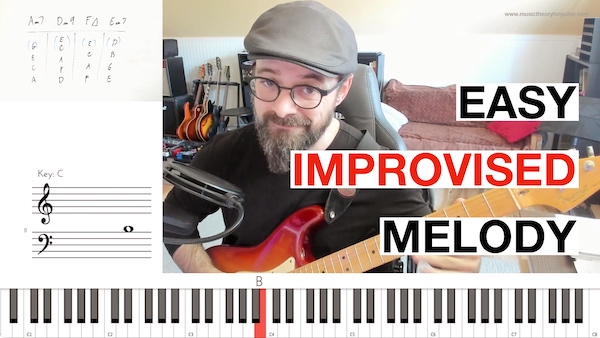
"I don't know how to improvise."
I hear this from guitar players all the time. And I get it — improvisation looks like magic when someone else does it. They just... play, and it sounds good, and you have no idea how they're choosing those notes.
But here's a secret: most improvisation isn't really about choosing the right notes. It's more about having a system — even a ridiculously simple one — and trusting it.
One Formula, Infinite Solos
In the video below, I show you a trick so simple that it has a 100% success rate. Every single time you apply it, it sounds good. And I mean every time — I've never seen it fail.
It requires almost nothing: a scale you can play over your chord progression, and knowing a few chord tones. That's it.
The formula itself? I give it away in the first two minutes of the video, because I'm not going to make you sit through ten minutes of buildup. (You're welcome.) The rest of the video is worked examples so you know exactly how to apply it.
The best part is that this exercise is infinitely extendable — the moment it starts getting predictable, you change your 2-3 starting notes... and suddenly you have a completely fresh set of phrases. It never gets old.
If you want to use this system but you're not sure about notes on the fretboard, grab my free guide to learning the notes on your guitar fretboard — it takes about 5 minutes a day for a few weeks, and then you'll know every note on the fretboard even before your morning coffee.
Video Transcription
Hello, international eyes to see you. This is a very, very, very simple trick to improvise. And if you do not know how to improvise at all, this is a fantastic starting point.
With this trick that I'm going to show you right, I just plan it and I'm just going to show you right now exactly what it is. This trick is infinitely extendable. You can be very creative with this, but it's also very, very simple to apply.
You can apply it in real time and it works over any chord progression and it never pays 100% success. Every single time you do what I'm telling you to do, it sounds good and especially it makes you sound like you know exactly what you're doing.
I'm going to give this away immediately. I'm not going to make you wait minutes and minutes into the video. The trick is super simple. You take any scale you can play over your chord progression.
So you need to know your chord progression. You cannot just randomly go to the chord progression and you need to know what scale to play on top. Once you know that, and again, typically pretty simple, you're going to pick two or three random notes over this scale.
And you're going to play those scales the same way in the same, sorry, those notes, the same way in the same order over every chord in the chord progression. And then after that, every time you play it, you're going to follow them with a note of the chord you're playing on top.
Okay, that's it in a sentence. Now, the details are a bit more complicated, so we're going to go down. Now I'm going to see exactly what you can do exactly what to do and I'll make it work for you. I'll show it to you in real time.
So let's go to the board and let's see what's going on. So again, the formula for our phrases is these two or three random notes followed by one chord tone. These is the magic formula. Two, three random notes always the same for that one chord note or every chord.
So let's take the chord progression I was playing on a moment ago. Okay, it's, the chord progression was playing on a moment ago. It's these. It was A minor seven, D minor nine, F major seven, and E minor seven.
And I can write under here the note of the chord A minor seven is A C E G D minor nine is D F A C E F major seven is F A C E minor seven is E G B D. Those are the notes on of my chords. Okay, over all these chord progression, I can play the A minor pentatonic.
I could play the, I could also play A Ionian over these and maybe A Dorian over here or other possible combination. Okay, I can probably sneak in occasionally. I'm a lot of D minor harmonic minor, but no matter, I'm going to pick the simplest option and I'm just going to play the A minor pentatonic over these.
Okay, the A minor pentatonic is super simple. A minor seven, D minor nine, F major seven, E minor seven. That's the thing. Okay, simple and I'm playing this.
So what I'm doing is this. First of all, I want to make sure I am targeting some chord notes. So if it's the, this is the first time I'm playing on this chord progression, which is not, but if it was the first time I'm playing over this chord progression, the first thing I want to go is listen to it a few times.
Okay, and just make sure I know where I am every time that you see I'm going through. If an A minor seven, if a D minor nine, if an F major seven, if an E minor seven. And then I'm going to play some chord notes like C. Steve works here too. C works here too. But here I have to play B.
I can play C here. Maybe I can go down to an F here. And then an F will work here too. And then here I have to play B again or E or something. So I'm going to get familiar with the chord notes so that whenever something hits, I can hit a chord note.
Okay, easy, simple, but it doesn't sound great. It's up like an exit side. It just sounds like I'm targeting the notes. That's what I am. I just target the note. I just target the next note. I just target the next note. Next note could be the same. I just target the next note. Then target the next note.
I get the next note. Okay, again, that's preliminary work. That's not what I want to do all the time. It's just preliminary work to get to know the chord progression. Then once I can do that, the fun start. I pick two, three, random notes. I mean, definitely that. Now one, three, three, or one, three, or one, three, or one, three, or one, two, three, it doesn't matter.
Okay, indeed. I don't even remember what I played at the beginning of this video because it doesn't matter. Okay, but let's say I play, I don't know, A and then E. So what I'm going to do on when A minor seven arrives, or just before A minor seven, or when either when A minor seven start or just before, I'm playing my two fixed notes in this case, I'm going to play A and E, and then I'm going to play one of the notes of A minor seven.
I already play A and E, and I can play them again. I could go A, E, A, or A, E, but I can also go A, E, C, or A, E, G. Now, this is a good moment to notice that it's typically better if you target mostly the notes of the triad. Okay, as opposed to the sevens and the ninths, you can target the sevens and the ninths.
There is no problem. When you get started, if you target the note of the triad, you're going to get a more predictable sound, and predictable in this case, it's good for you because if you know how it sounds, you can make a sound.
Anyway, I'm playing A, E, C. When the D minor nine chord arrives, I'm still playing my two fixed notes A and E, which again I chose randomly and I could have picked anything else. But then I play either the an F or an A, so I can go A, E, D, or A, E, F, or A, E, A.
When F major, F major seven arrived, I'm going to play again the A and the E, but then I can play either an F or an A or a C. And now, this is that if I play the C, I will play the same thing, I play only minor seven, but that's not a problem.
Okay, it still works. And when I get an E minor seven, I'm going to play A, E, and I can play E again, or G, or B. In this case, I should check and find the closest B. Okay, of course you need to know that you're not in the fretboard, but that's okay.
You can learn from the fretboard. I do have a system here on how to learn notes on the fretboard. It's going to take five minutes a day for a few weeks. You follow the exercises in here. You know, all the notes on your fretboard.
When you wake up in the morning and you're still groggy before your coffee, if you follow the exercise in here, you'll know exactly what are the notes in the fretboard on your fretboard. It's uncanny. It works just to the exercises in this ebook.
Okay, and it's great. Go at the link down here and download it. No string attached, but having back to our thing here. So, essentially, you play the two fixed notes, and again, I pick the two fixed notes randomly.
And then you hit a note of the chord. Okay, so in real time, I'm going to let's go through all the back-in rock. Wait, I'm A, but I'm seven. I'm D, but I'm nine. Let me do it. No, it's okay.
Hey, that always sounds good. Okay. It always sounds good. Of course, I'm picking a different chord note. I have a different chord note every time, partly because, you honestly don't remember what I played the four bars before.
Okay, I had the memory of a goldfish, so, but partly because it just sounds more interesting if I change it every time. The moment it gets boring, and it gets boring after four to eight bars, you pick another two or three notes.
There's no problem, and you can pick them in real time just to improvise. Two or three random notes, every time the chord progression goes through. Now we are here, in my room nine. I'm going to pick something like that. And I change it.
And you can go on and on and on. Okay, whenever you get bored, pick other two or three notes. Play them every chord. And with another chord. Bum, instant improvisation, this trick works every time. Every time, and it pretty much never gets old.
The moment it starts to get old, change the rhythm, play more notes, play less notes. Maybe do a part where you're just noodling on or random notes or set my random notes. And then go back to this.
Simple as that. This is the best exercise to start improvising. If you've never improvised before, this is the thing. This is the thing. Okay, it is super easy. If you cannot do it with four chords, do it with two chords. Find the back and track with two chords.
It's easy. It's fun. If it's too complex, use less notes. Use only two, random notes. Use only one random note or play only note of the chord. The more you get confidence, increase the number of notes. You do this for a few minutes every day in a couple of weeks.
You start to become a decent improviser. Even if you have no idea what you're doing beside hitting a few chord notes. Try it. Try it. It changes your life. It's a completely different view on improvisation than what you normally see. And it changes the way you play or the better.
Okay? Have fun with this exercise. This is Tomada Delia of Mrrefergitan.com. And until next time, enjoy.