How To SOLO Over A II-V-I Using Only PENTATONIC Scales

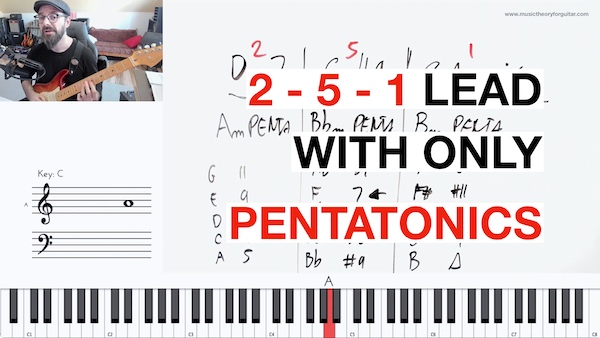
Every rock guitarist knows the minor pentatonic scale. It's the first scale most of us learn, and it's the one we keep coming back to — because it works.
But here's the thing: that same pentatonic scale is also your ticket into jazz soloing. Specifically, it's all you need to start soloing over II-V-I progressions — the quintessential jazz chord progression.
No, you don't need to learn Mixolydian b9 #13 or whatever terrifying name your local jazz school would throw at you. You need a pentatonic scale and a simple rule for when to switch.
Two Options, Same Shapes
In the video below, I show you two approaches — both using nothing but minor pentatonic shapes you already have under your fingers:
- The standard option — one pentatonic for the II and V chords, shift up two frets for the I chord. Safe, musical, works every time.
- The adventurous option — a different pentatonic per chord, moving up one fret each time. All tension notes, all the time. Requires
nerves of steela bit of practice and the jazz face.
Both are surprisingly easy to play. The hard part isn't the technique — it's trusting that it actually works.
If you want to go deeper and learn the complete system — full scales, modes, arpeggios, and how to improvise over any chord progression — have a look at my Master of the Modes course.
Video Transcription
Hey, look at the nice and nice to see you. This is a guide on how to play on two five ones for rock lead guitar player. If you are a rock player, there is one thing you know. And you know really well. And it's a pentatonic scale. You know exactly how to play a minor pentatonic that is this.
And so we are going to build this whole little guide only using pentatonics. Now this is a complete guide. Now it's an introduction because of course when you play all these then you then would like to actually target the chord notes and hit the right notes and all this kind of thing.
But right now we ignore that that's a getting started guide that's something to get your feet wet to get started that later you can do more things in it. You just get confidence by doing this and then you do more.
Now you may like what you play what I played you may not like what I played there are many styles. I'm going to show you a couple of options. This actually was the most risky option, but I wanted to start with that just to show you what that the possibility is okay, but I'm going to show you more than one option.
They are all super easy there and again if you know how to play a pentatonic that's going to be easy. So how does it work? Well let's see a little bit what are we playing on shall we okay.
And so let's get to the whiteboard and so that's the whiteboard okay we are playing over a two five one in C major decor type was playing over our D minor seven. I was playing over a G seven with a flood five sorry a flood nine not a flood five a flood nine and then I'm ending on a C major seven for two bars that's means second bar of the same. Okay.
If I had to write down the tablature for those okay this would be whoop this is a ten and ten easy this is ten nine and nine okay and this one here is eight nine eight nine nine eight not too hard to play I'm going to play them now I'm going to switch to the camera so you can see my fingers I'm playing the D minor seven flood a minor seven this way in which the middle finger hits the six string and the ring finger bar string to three and four and the other two strings and the first string and the fifth string are muted.
I am doing the G actually let me do this all right wait this is okay so now you can see the tablature so the I am playing the G seven with a flood nine by barring with my index finger at the ninth fret and putting needle and ring on the tenth fret this way and then finally the C major seven for the standard shape okay in which I use my index finger on the six string and the other three fingers this way that the shape I want very easy very easy.
Simple shapes to play those chords what am I playing on those well actually they're going to start with a simple option what you heard before was actually the more complex up you're going to start with a simpler option first just to get our feet wet just to get started with our woman I'm gonna give you what I call the standard option okay because it's the one that actually most people use most of the time it's documented if you want in so many jazz books that we're doing this and the idea is this on the minor seven and G seven flat nine and this could be any kind of dominant chord it could be a flat nine a normal nine okay a sharp nine a flat five a sharp five a six they can be a number of things here okay.
And we are not too strict with our chord scale correspondence here because it's jazz you can put some dissonance here and there and it still works and in fact the idea is that the choice of dissonance that you like it's up to you. I know the purist or the people who went to I'm a jazz school we go like no you cannot play this over that because there is this dissonance yeah no I know I know but then while when you go in the wild then you actually go to a jazz club and listen to what they play or you actually listen to the classic recording musicians do miss match scales and chord all the time and it still works because that's an important thing the important thing is to make them work.
So but what do we play here a simple way to play here is to play the D minor pentatonic here and to play the E minor pentatonic here. Okay what are the notes of the D minor pentatonic the notes are D F actually put them in the other direction and it's up from here and it's a D F G A and C those are the notes of the D minor pentatonic D F G A C.
Okay on D minor seven those are the root third the minor third of course the fourth or eleven the fifth and the seventh these scale of course fit these perfectly okay it's the scale of this chord. It fits this in a slightly different way because the D is the fifth the F is the seventh so so far no problem the G is the root no problem the A is the ninth this could be a problem and the C is the 11th or 4th I'm gonna put 11th there could be a conflict going on here and there could be a conflict going on here and it is nine probably we'll clash with a flat nine that I have in the backing track.
Okay the backing track is what I played just before it's just a loop pedal okay you don't have to have anything fancy for that. The 11th can conflict with the third in here okay the C note can conflict with the B note in the G we are gonna ignore that it's gonna work okay as long as you don't stop too much on those.
If you're really worried about these well then start with just playing the D minor pentatonic and then when you are on G rather than playing the C transition this to a B okay so you can instead instead you can play a B note instead so you play D F G A B so just modify the pentatonic over here and for the ninth yeah if you want to play on A flat play on A flat it could work but honestly not a big problem.
The E minor pentatonic over C major 7 it's a fairly documented choice to it works beautifully E G A B D respect to the C major that's the third the fifth the sixth the major seventh which I'm gonna put it triangle and the ninth. Fantastic note choice okay we are not we do not have a C anywhere we don't care you don't really want to play the root over this kind of chord anyway.
Okay I mean it's it's not a great choice to play the root over the root over the root chord it sounds a bit too much okay it's like to it kind of stops the song okay so you don't want to do that okay so that's a fantastic no choice so let me show you what I'm doing and essentially I'm setting the backing track and I'm here right now.
So D minor 7 D7 flat 9 C major 7 and then I'm just playing it in the tonic I'm just playing the scale right just getting used to it.
So whenever I'm here I'm just playing D minor. Whenever I hear I'm just playing D minor pentatonic and I'm just playing everything in the basic shape just playing everything in the super basic shape I like it. That's this.
Okay. I feel like okay nothing nothing I really congregated on as well okay maybe a bit fast in places but not really complicated I'm just playing the D minor pentatonic at a time flat and the E minor pentatonic at a time flat and one less that's enough to carry me over okay through these changes.
Okay and nobody will complain about that okay well unless they know exactly what they are doing what you're doing and they see what you're down and they will tell you there is a conflict between the notes but otherwise most people hearing these even good musicians will not notice that there is a mismatch if you make it work your my age may vary.
Okay so essentially how does that work you do what there is a two five one in C major you play on you on two and five okay I'm just making clear that's the two that's the five that's the one okay on the two you play the pentatonic the minor pentatonic with the same name and you carry it over on the five and when you get on the one you just take the same pentatonic pentatonic and you move up two threads.
That's the rule that's the simple basic rule that's what I call the standard option okay that works pretty much every time regardless if these cordies are altered or not it works pretty much every time. Again if you really really really really what's happening here oops I clicked the wrong button if you really really really really really want to may I have the not a mismatch here okay whenever you play on a second play the standard the minor pentatonic whenever you get on the fifth I then play in the C play the B.
Okay how does that sound this way so and then and then you might open the tony you might open the tony if it's a B and then you might open the tony.
If you can hear the difference of course because it's okay there is a difference it's not so big difference you may like this difference and if you like this difference it's worth to implement this little change you know that's the basic option.
Now what if we want to do something fancier though okay what if we want to do something like what I was doing at the beginning of this video okay that's the second option not too hard honestly again but we have an extra pentatonic.
Okay what I was playing at the beginning of this video is this on the minor pentatonic I'm playing an A minor pentatonic. On the G7 at 9 pentatonic I'm playing a B flat minor pentatonic. And on C major I'm playing a B minor pentatonic again there's a a bit more of an advanced choice.
And then what happens is that the first time you play this yourself it can sound a bit weird you are not used on how these pentatonic sound over this chord you're not used and you're not used on this the way that this pentatonic sound over this chord because all the all the all the pattern of rest note and tension note inside the pattern is kind of reversed so when you play your normal licks they sound weird.
The solution here is to know that it's gonna sound better when somebody else is playing okay it's probably gonna sound better to you when I play it simply because I'm more used to it and you don't know what I'm doing and you know what you're doing but when you play if you know what you're doing you know how you're supposed to sound you kind of expect a sound and you get a different sound because there isn't much between the scale and the chord not a problem you will see in a moment the notes are all correct that they are just in the position you don't expect inside the pattern.
Now let's see what this gives us this thing here the note of the a minor pentatonic car a c d e g over d minor seven that's the fifth the seventh the root the ninth and the eleventh. Fairly it's it's a good choice the all those notes sounds nice over this chord the b flat minor pentatonic it's the same just one front above so I have b flatum d flatum e flatum f up and a flatum.
Over these these is a sharp nine this is a flat five this is a sharp five this is the seven and that's the flat nine and these pentatonic gives you all the alteration over this chord. The there is no rest note here there is no note in which you can stop and relax because none of these notes is really concerned and to this except maybe you mean the most concern note is the they have been the seventh which is not really the most concern note.
Okay so none of these at rest notes this part and this pentatonic here it's all tension notes but those are the right tension notes okay so when you are here the idea is keep going don't stop okay and make the jazz face.
Okay and just keep going but it's gonna work out okay when you are over here the notes of the b minor pentatonic are b d e f sharp and a and over these c major that's the major seven the nine the third the sharp eleven sounds great that's not really a decent and the six the all good notes the most consonant one being the third.
Okay those are all particularly all tension notes okay except the so even this one tend to sound a little bit weird. Now that's interesting because those notes are all tension notes and the and the less tense is the e if you were playing this b minor pentatonic over a b minor chord which are not right now but if you were playing this over a b minor chord this e would be the most dissonant among all of them.
So if you are used to play your pentatonic over minor chords like you do normally in rock you kind of learn to avoid this note avoid stopping on this note I mean you don't do it consciously just do it because that's what happens when you when you play so just learn to avoid this one and because it stands and now in this case instead this note becomes the most consonant so when you play your normal licks this kind of works against you.
Okay so just you know that that could be this problem anyway how does this all sound again first of all notice now a minor b minor b flat minor b minor the pentatonics are all close by going up one fret let's next this option very easy to play okay it sounds good this way already.
Okay when I play again we are here we are here then I have one part of this and one part of this so let me play just this game. Yeah.
Okay that's how this case sound by themselves. And honestly, when you play them this way, they're okay, not great, because at this point it starts to be a little bit of a trickery to make it work and as usual it's not just a scale, it's to make it work.
What you want to do when you play this is that when you change between one scale to another, when you go from this scale to the next one, you don't really want to jump like a bit before again and we're just playing the scale. It doesn't jump, and you would like to go.
You want to reach with a note close by whether or not going up in the next pentatonic, but the note is going down in the next pentatonic, okay. It doesn't matter, the point is you play a phrase and you try to continue into the next chord by switching so that the last note of the first scale and the first note of the second scale are close by and you're not making a jump right there.
And if you do that, everything sounds much, much smoother, okay. What I would recommend at the beginning is make a back-end track like these, really not really complicated, and make it super slow, just play the scale on top like this.
Something like that, okay. If you take his low, you just get used to it. And he gets better and better and better and better, okay. Right now I'm just playing some simple stuff. I don't want to use too much trickery here because I don't want to give you too much of an idea that it sounds this way and you try this completely different.
I'm using very little trickery right now. I'm just literally playing the scale up and down. I am now targeting the chord notes at all. I'm just playing the scale. So occasionally, yeah, I'm hitting every note and it's jazz. That's no problem.
Again, just play the scale. You try those two options. You learn to play a little bit over this kind of jazz chord progression. It gets easier and easier. Now again, let's also review in this new option, when you play these on a 2, 5, 1, you want to play the pentatonic minor that it's a fifth above the D minor 7, the 2. Or you can think of it as just the relative minor of C because C major pentatonic and A minor pentatonic are the same scale after all.
Okay, well, not really the same scale, but they have the same notes. Okay, so you can just think of it and then just go up a half step on every chord. You start this with the A minor over D minor 7, go up a half step, go half half step. Okay, two simple options that you can use and they will work fantastically for you.
If you want to know more about all these, okay, yeah, I do have a course. The course is called Master of the Mods. Okay, in Master of the Mods, I take a more systematic approach if you want. I'm not doing only pentatonic, I'm actually starting you on the full D minor tonic scale and we get to know also the not only the normal major and minor scale and all the mods, but also the mods and melodic minor, the mods of Armonic minor and we see all of them work over any chord progression.
So it's way, way more systematic than this. Okay, and then we also translate all these into pentatonic because you have several pentatonic choice and then we translate also these over our pages because you have several possible arpeggios over on all of these and then we put everything together until you can improvise over any chord progression using any choice you want among all the scales and mod existing in the world.
So have a look at that. Okay, you can even have a lot of fun with that. Now, try those two options. See if you like them and have fun until next time. Enjoy this is Tomas Zilya for guitar. I'll see you guys next time.